Quarter Drops and Pepperoni Grease: A Road Trip Through America's Forgotten Arcades
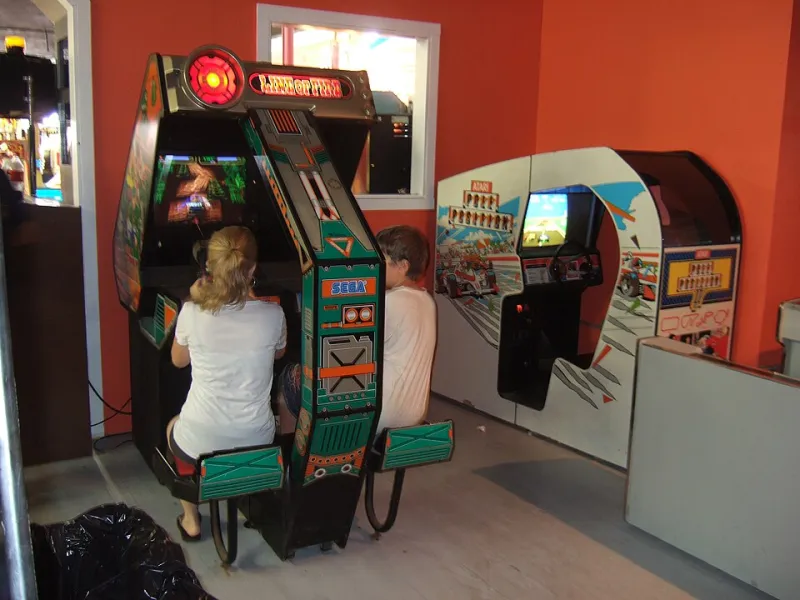
Photo: Rob DiCaterino from Jersey City, NJ, USA, CC BY 2.0, via Wikimedia Commons
The first thing you notice is the sound. Not the music — that died years ago in most of these machines — but the thunk. A quarter, dropped hard onto glass, rattling into a coin box that somebody still empties every Sunday.
I heard that sound six times in two weeks, in six towns across four states, and by the third time I realized I wasn't really chasing arcade games. I was chasing the people who never got the memo that arcades closed.
The Arcade Didn't Die. It downsized.
We all know the story: the golden-age arcade, the mall palace with forty cabinets and blacklight carpet, gone the way of the record store. But here's what the obituaries skipped. The machines didn't vanish. They migrated.
They moved into the unglamorous places — the family fun center off the highway exit, the pizza joint with the buffet, the bowling alley where league night is sacred. There, wedged between the air hockey table and a gumball machine, a 1982 cabinet hums along, earning maybe thirty dollars a month. Nobody's retiring on that. But nobody's hauling it to the dumpster, either.
At a bowling alley in Muncie, Indiana, the owner — a guy named Dale who's run the place since the Carter administration — keeps three machines in the snack bar corner. One is a Ms. Pac-Man that has eaten more quarters than the change machine.
"I've had offers," Dale told me, wiping down a lane. "Collectors call. They want it bad. But what am I gonna put there? Another empty space?"
Kids Raised on Smartphones Still Walk Over
Here's the part I didn't expect: kids play these things.
Not a lot of kids. Not every day. But at every stop, I watched it happen — a ten-year-old, phone in pocket, abandoning the tablet mounted to the booth for the chance to stand in front of a screen that's older than their parents.
I asked one kid in a pizza place outside Toledo why he liked it. He shrugged the way ten-year-olds do and said, "You get better at it. Like, actually better. You can't just buy the good part."
Then he went back to dying on level two.
That's the thing a smartphone can't sell: scarcity. The cabinet gives you three lives and one opinion of your skills. There's no update coming. No patch. The game is exactly as hard as it was in 1983, and if you want to see the next screen, you have to earn it with your hands and your reflexes and — critically — your quarter.
Why a Quarter Hits Different Than a Tap
The tap-to-play card changed the economics of everything. Swipe a card, credits appear, credits vanish, nobody feels anything. It's frictionless, which sounds like a compliment until you realize friction was kind of the point.
A quarter is a decision. You dig for it. You hold it. You feel the weight of exactly how much fun you're about to buy — about ninety seconds of it, maybe two minutes if you're decent. When the game ends, the quarter is gone and you know precisely what it cost.
Every arcade owner I met said some version of the same thing: kids on cards play careless. Kids with quarters play like it matters. Because it does.
There's also the small matter of the coin door, the mechanical clunk of a credit registering, the way the machine acknowledges you personally. A card reader doesn't care who you are. A quarter drop is a little transaction between you and a machine that's outlasted four consoles, two recessions, and every fad since.
The Owners Keeping the Lights Blinking
The people maintaining these machines aren't running museums. They're running businesses. The arcade cabinet is a rounding error on their books — but a beloved one.
A woman named Rhonda runs a family fun center in western Ohio where the Star Wars trilogy cabinet has been broken for two years and she still won't sell it. "Somebody's grandpa fixed it once," she said. "He passed. So it stays."
She keeps a shoebox of replacement buttons and a YouTube tutorial bookmarked on the office computer. When the joystick sticks, she fixes it herself. When a part is truly unfindable, she improvises. There is a washer from a hardware store inside that machine doing the work of a part that hasn't been manufactured since 1987.
Nobody's documenting this. There's no plaque. The Smithsonian isn't calling. It's just Rhonda, a shoebox, and a machine that still works on Saturday nights because she decided it would.
Six Towns, One Lesson
I drove home with a paper cup of quarters — unspent, on purpose — and a theory I can't shake.
We keep talking about what got lost when the arcades closed: the social space, the glow, the high-score culture. All true. But what survived tells you something too. The arcades that endured did so by becoming furniture — background fixtures in places where people already gather for other reasons. Pizza. Bowling. A birthday party.
The game was never really the destination. It was the excuse to stand next to somebody, quarters lined up on the glass, waiting your turn.
That's still happening, in corners of buildings with sticky floors and laminated menus, in towns the algorithms forgot. Not everywhere. Not forever. But tonight, somewhere in Ohio, a kid is dropping a quarter into a machine older than their dad, and for ninety seconds, nothing else exists.
That's worth the gas money.