Your Lawn Is a Confession: What the Strip Between Sidewalk and Front Door Is Really Telling Me
There's a house on my street — I won't say which one, because the owner reads this blog — that is slowly disappearing behind an eight-foot cedar fence. It went up in panels over two summers, and every time another section appeared, the neighborhood group chat hummed with the same question: what are they hiding?
Probably nothing. And that's the part worth talking about.
Because after spending this past spring knocking on doors and asking people about their front yards — a conversation that sounds absurd until you realize nobody had ever been asked it before — I've come to believe the fence guy and the porch lady and the HOA board and the guy growing tomatoes in his parkway strip are all answering the same question. They're just answering it differently.
The question is: how much of yourself do you owe the street?
The Porch People
Dolores, 71, has lived on Maple Court for forty years and has never once drawn her blinds during daylight. Her front porch has two rocking chairs, a fan she rigged up herself, and a standing invitation. She estimates she knows every family within three blocks by name, and most of the dogs, too.
"People don't wander up to a porch by accident," she told me. "They wander up because the porch said come ahead."
For Dolores and the folks like her, the front yard is an instrument. Low hedges. A walkway straight from the sidewalk. A basketball hoop that belongs to everyone. The landscaping isn't really landscaping — it's an argument that strangers are just neighbors you haven't met.
There's real data behind the romance, too. Research on walkable, front-facing neighborhoods consistently links porch-oriented design with higher rates of casual social contact, and casual contact is the raw material trust gets made from.
The Fortress Folks
Then there's Marcus, whose fence I mentioned. When I finally worked up the nerve to ask about it, he laughed — a little embarrassed, mostly tired.
"I did the porch thing for eleven years," he said. "I waved. I chatted. I found a stranger's kid using my backyard as a shortcut to the cul-de-sac, twice. And you know what? I'm a man who works nights and sleeps days. My yard isn't a statement. It's a bedroom wall."
Here's the thing: I believe him. And I think we do people like Marcus a disservice when we treat privacy as antisocial. Sometimes a fence is a boundary, and boundaries are how adults with jobs and infants and anxiety stay functional enough to be neighborly at all. Marcus still shovels the sidewalk in front of his house — for the mail carrier, for the schoolkids — without being asked. He just doesn't want to do it in conversation.
The HOA Middle Kingdom
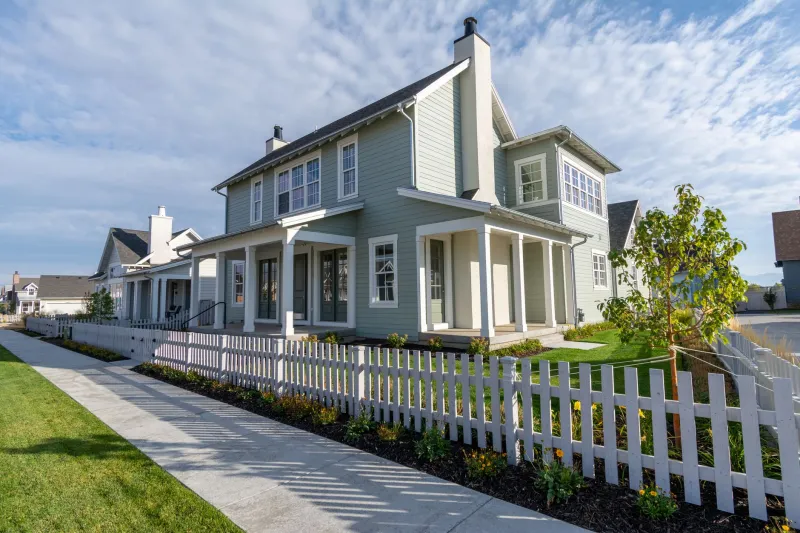
The third type is the one nobody asks, because they blend in: the lawn that is fine. Three inches of fescue, a boxwood pair, a seasonal flag rotated per the community handbook. This yard has no enemies and no opinions.
Or so it seems. Janet, who sits on her HOA board in a suburb I'll leave unnamed, made a case I didn't expect. "Uniformity isn't about control," she insisted. "It's about the promise that nobody's yard will ever be the reason your property value drops. We're buying predictability."
Maybe. But predictability is just privacy by committee — a fence you don't have to build yourself, made of matching shrubs. It says: I'll participate, but within approved parameters. That's not nothing. That's also not Dolores.
What the Grass Knows
Standing back, I don't think there's a right answer here, and I'm suspicious of anyone who says otherwise — including my own nostalgia for porches. The porch lady and the fence man are both making rational choices about exposure, and different temperaments and life stages demand different levels of it.
But I will say this: the yard is where the choice becomes public. Every strip of grass in America is a small, daily referendum on how much community a person can afford — emotionally, financially, physically. The retiree with the rocking chairs and the night-shift worker with the cedar panels aren't opposites. They're the same impulse, measured in different units.
So before you judge the eight-foot fence on your street, ask what it's protecting. And before you romanticize the porch, ask who has the leisure to sit on one. The yard doesn't lie. It just speaks a dialect we've stopped translating.
The fence is finished now, by the way. Marcus hung a bird feeder on the outside of it, facing the street. I'm choosing to read that however I want.