Eight Seconds of Eye Contact: What Cashiers Actually See When They Scan Your Groceries
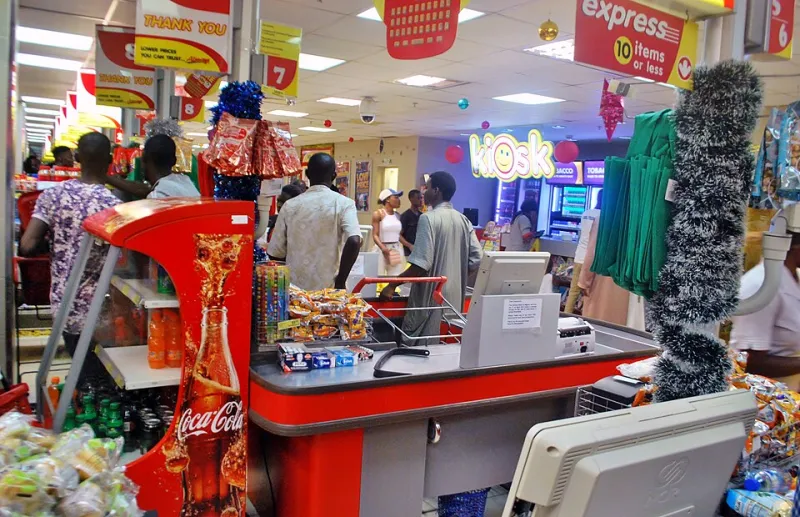
Photo: Jamie Tubers, CC BY-SA 4.0, via Wikimedia Commons
There's a moment that happens at every register in America, roughly eight seconds long, when the cashier and the customer are stuck with each other. The scanner beeps. The small talk starts or doesn't. And in that sliver of time, a person who stands in one spot for a living takes in an enormous amount of information about the person in front of them — and, more interestingly, about the whole town marching past on the conveyor belt.
I spent the last few months talking with three longtime grocery cashiers — a woman in rural Nebraska, a man in a New Jersey suburb, and a woman at a busy co-op in Seattle — and what they see from behind the belt is better reporting on American life than most polls.
The Cart Is a Ledger
Darlene, 61, has run a register at a single independent grocery store in Broken Bow, Nebraska for twenty-nine years. She can tell you when the corn made money because the carts fill up differently.
"Good year, people buy steaks and name-brand cereal," she told me. "Bad year, it's beans, rice, and whatever's on the day-old rack. And everybody pretends it's about taste. It's not."
The cart, in other words, is a ledger the customer doesn't know they're keeping. When the local plant laid off forty workers, Darlene watched the same shoppers' carts shrink for three straight months. She also watched a retired teacher quietly hand her WIC vouchers over to young moms in the parking lot — a thing Darlene saw because the checkout lane is one of the few places in town where everybody, rich or poor, has to pass through.
The Suburban Reading List
Marcus, 47, works at a big-chain supermarket in central New Jersey, the kind with thirty lanes and a Starbucks. His version of town intelligence is subtler. He knows which households are going through a divorce ("carts get weird — single portions, all of a sudden, and nobody buys the big box of anything"), which ones just welcomed a baby, and which ones are struggling, because struggling in the suburbs looks like a cart full of store brand and a kid asking if they can get the cereal with the toy.
He also noticed something that surprised him: the weekly big shop is dying. "People come in three, four times a week now, small baskets," he said. "Nobody plans anymore. They're buying dinner the way they buy gas."
That's not just a shopping habit. That's a whole economic posture — wage stagnation showing up as a shorter shopping list.
The Last Democratic Space
Priya, 38, works the register at a Seattle co-op where the customers include tech executives and line cooks and retired professors. She made the point that stuck with me longest.
"There's almost nowhere left where everyone in a zip code physically stands in the same room," she said. "Church, sure, for some people. The DMV, but nobody talks there. The checkout line is it. You're face to face with a stranger, there's a script, and for eight seconds you belong to the same little economy of beeps and bags."
That's why the self-checkout wars feel like more than a labor dispute. Every lane that goes automated removes one of the last places a town reliably bumps into itself. The cashiers I talked to aren't sentimental about technology — Marcus likes self-checkout on his breaks — but they all said some version of the same thing: the register is where the town checks in.
What They Wish You Knew
A few things came up with all three, unprompted:
- They remember your heartbreaks. Darlene has rung up funeral casseroles for the same family three times. She never says anything, but she sees it.
- The nicest carts often belong to the tightest budgets. "People buying the cheapest food tip the best and the most often," Marcus said. "I don't know what to do with that information except tell you."
- They can clock a bad week in under a minute, and most of them do something small about it — a discount they probably shouldn't give, a bag packed gently, a "see you Thursday" that means more than it sounds.
The Eight-Second Town
Here's the opinion part, since this is the part of the site where I get to have one: we should probably stop treating cashiers as furniture. The person scanning your oat milk has processed thousands of hours of your neighborhood's quiet data — its layoffs, its new babies, its generosity, its slow decline or slow revival. They are, collectively, the most complete census we have, and we're automating them out of the building.
So the next time the belt starts moving and you've got eight seconds of nothing to do, look up. Say the thing. Ask how their shift is. You're not just being polite to a stranger.
You're checking in with the person who knows your town better than the mayor does.