While the Rest of Us Dream: Twelve Months Embedded in America's Overnight Shift
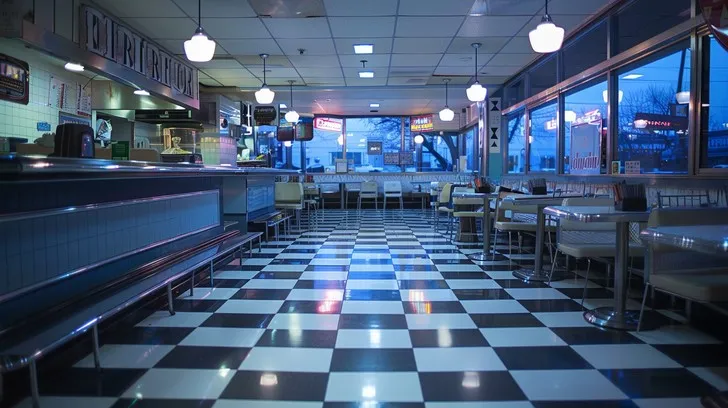
Photo: night shift worker empty diner early morning fluorescent lights, via images.stockcake.com
Somewhere around 3:40 a.m., somewhere between your last dream and your first alarm, a man named Curtis is mopping the fourth-floor hallway of a hospital in Dayton, Ohio. He has done this roughly 250 times a year for eleven years. You will never meet him. You will never know that the floor you're wheeled across was sanitized by his hands at an hour when you couldn't have found that hallway with a map and a flashlight.
Curtis is one of four people I followed for a full year for this series, and I'll be honest about why I started: I wanted to know who was awake. Really awake, not doom-scrolling awake. Who keeps the lights on, the bread moving, the dial tone warm while the rest of the country is horizontal?
The answer turned out to be bigger and stranger than I expected.
The Parallel Country
Here's the first thing nobody tells you about the night shift: it has its own weather. Not meteorological — social. Around 2 a.m., the energy in any 24-hour building changes. The lobby empties. The voices drop. The people remaining aren't passing through anymore; they're in it, and they all know it.
At the hospital, Curtis taught me the term for it: "the skeleton crew hush." At the diner in Terre Haute, Indiana, where a cook named Dot has worked the grill since 1998, they call the same phenomenon "the second lobby" — the moment the night regulars become the whole population. At the bakery depot outside Grand Rapids, where a driver named Marisol loads racks of bread at 4 a.m. sharp, nobody calls it anything. They just move faster.
Different vocabularies, same country. Roughly 15 million Americans work non-daytime hours, according to the Bureau of Labor Statistics, and a meaningful slice of them are holding down the hours between midnight and dawn. They stock your shelves, drive your ambulances, restart your servers, and fry the hash browns you'll order at 6:15 a.m. without ever wondering who made them possible.
Loneliness Is Real, But It's Not the Whole Story
The easy narrative about overnight work is isolation, and I won't pretend that isn't part of it. Marisol told me she once went three weeks speaking only to the loading dock guard and her dispatcher. Dot's kids grew up thinking dinner was breakfast. Curtis works an entire wing of the hospital some nights without exchanging ten words with anyone.
But spend enough 3 a.m.s with people and a different picture emerges — one the daytime world rarely gets to see. The night shift doesn't have meetings; it has rituals. Dot keeps a running bet with a trucker named Gene about whether the frost will hold past Valentine's Day. The radio host I followed in rural Nebraska — a man named Rick who does a four-hour country and call-in show to an audience of maybe 4,000 insomniacs, truckers, and farmers — gets voicemails he describes as "confessions with a twang." People tell things to a disembodied voice at 2 a.m. that they'd never tell a spouse.
The camaraderie isn't loud. It's structural. Night workers wave at each other the way boat captains do — a recognition that only other people in this specific water understand what the water is like.
What the Day Owes the Night
Here's where I'll climb onto a small soapbox, because a year of this reporting changed my opinion, and opinions are what this section is for.
We treat overnight work as a footnote — lower pay in many cases, worse sleep always, a schedule that cardiologists and sleep researchers keep telling us is quietly hard on the human body. And yet the entire daytime economy is built on a foundation of people who finished their work before ours began. The hospital hallway Curtis mops is only as safe as its cleanest hour, which is usually the hour nobody's watching. The bread on your shelf exists because Marisol's van left the depot before the birds did.
I'm not arguing for performative gratitude. I'm arguing for attention. The night shift is invisible mostly because invisibility is convenient. We don't see the systems that work, and the overnight economy is a system designed to go unnoticed.
So here's my modest proposal: once this month, when you're the only customer in a 24-hour diner at 5 a.m., or you're wheeled down a hospital corridor before sunrise, or a bakery truck rumbles past your window while you're making coffee — look up. Make the eye contact. Learn a name.
Dot put it better than I can. "People think we're working the graveyard shift," she told me, flipping something on the grill at an hour I can no longer remember. "Graveyards are quiet and final. This? This is the opposite. Everything's still possible at 3 a.m. Nothing's been decided yet."
She's right. The night isn't where America goes to sleep. It's where America keeps a second set of books — quieter, stranger, kept by people who will wave at you from the dock and never expect you to wave back.
You should wave back anyway.