Thirty Stamps, Thirty Strangers to My Gratitude: A Month of Mailing Thank-Yous Like It's 1994
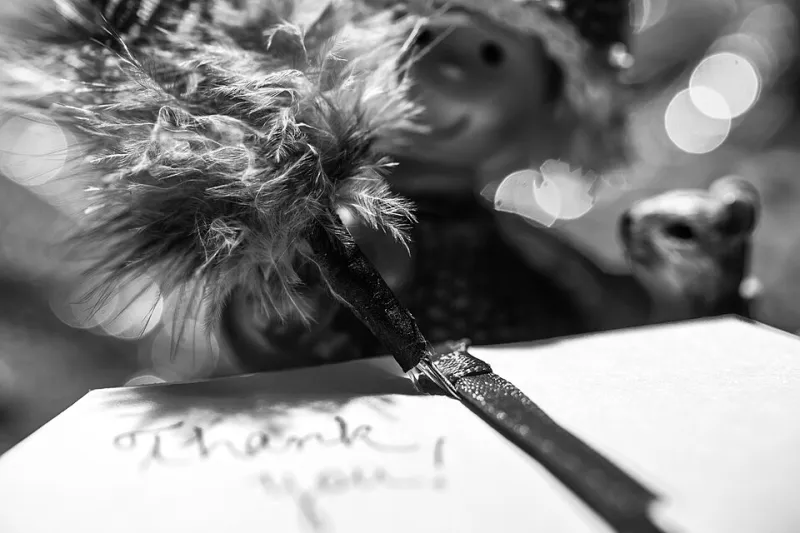
Photo: Carol VanHook from Tennessee, USA, CC BY-SA 2.0, via Wikimedia Commons
The first note almost didn't get sent. I'd written it to Mrs. Halloran, my fourth-grade teacher, a woman I hadn't seen since Clinton Davis's going-away party in 2003. I told her I still remembered how she read Charlotte's Web out loud and stopped at the sad parts on purpose so we could sit with them. I folded the paper, addressed the envelope, licked the stamp — and then held the thing over the mailbox for a solid ninety seconds like it was going to bite me.
Here's the problem nobody warns you about: gratitude, delivered instantly, is easy. Gratitude delivered nine days late, in your own handwriting, with your actual handwriting — the handwriting you've spent twenty years hiding behind keyboards — is a small act of exposure. There's no delete key. There's no "seen" receipt to reassure you. There's just you, a mailbox, and the knowledge that somewhere out there, a person is going to unfold a piece of paper and read your inner monologue in cursive.
I mailed it anyway. Then I mailed twenty-nine more.
The Rules I Made Up as I Went Along
This wasn't a scientific study. It was a personal experiment with loose parameters, which is the best kind. The rules, such as they were:
- One note per weekday for six weeks, roughly thirty total
- Handwritten only — no printing, no cards with pre-written sentiments
- Recipients had to include at least a few people who weren't obvious choices
- No expectation of a reply, stated or implied
The obvious choices came first: Mrs. Halloran, my high school journalism advisor, my grandmother's next-door neighbor who shoveled our walk every winter without being asked. Then I got braver. I wrote to Dennis from my first job, the guy in the cubicle next to mine who taught me how to expense a client lunch without committing tax fraud. I wrote to the children's librarian at the Fairview branch, a woman named Carol who I'm fairly sure once let me check out a seventh book when the limit was six and never told a soul.
And then came the near-strangers. The woman at the dry cleaner who noticed when my dad died and stopped charging me for his dress shirts. A former manager who wrote me a recommendation letter eleven years ago that I'm convinced is the only reason I got hired anywhere. A guy I sat next to at a wedding in 2019 who said one sentence about his own divorce that rearranged something in my chest, and who I never thanked because, well, how do you thank someone for that?
Apparently you thank them on note paper from the drugstore, that's how.
What Slow Gratitude Actually Feels Like
We've trained ourselves to believe that a feeling isn't real until it's transmitted. You feel thankful, you text, the person gets it in four seconds, transaction complete. It's efficient. It's also weirdly weightless.
A mailed note works differently. For one thing, there's the lag. You write it on a Tuesday full of feeling, and by the time it arrives, you've half-forgotten the feeling — but the recipient hasn't seen it yet. The gratitude is out there ripening somewhere in a USPS sorting facility in Indianapolis, and you have no control over when or how it lands.
For another thing, paper is physical evidence. A text gets buried under forty-seven group chat messages by nightfall. A note gets stuck under a magnet on the fridge. Carol the librarian told me later she propped mine on the circulation desk for a week. Dennis texted me a photo of it pinned to his home office corkboard, next to a photo of his late wife.
I hadn't thought about it that way before: in a life full of disposable communication, a piece of stationery becomes an artifact almost by default.
The Conversations the Stamps Started
Here's what I didn't expect: about two-thirds of the recipients responded. Not all by letter — some texted, some called, one showed up at my door. But every response started a conversation that went further than any of my instant messages have in years.
Mrs. Halloran sent back a page-and-a-half letter. She's retired now, lives near her daughter in Tennessee, and she told me that teachers rarely hear whether anything stuck. "You water a garden for thirty years," she wrote, "and mostly you just hope it rained." I've thought about that sentence roughly four hundred times since.
The wedding stranger — his name is Marcus, by the way, I finally learned it — called me and we talked for an hour. He's remarried, lives in Minneapolis, coaches his stepson's basketball team. We now text occasionally. A near-stranger became an actual acquaintance because I spent forty-five cents and eleven minutes of handwriting.
Not every note landed perfectly. One former coworker responded with a curt "Thanks, that's sweet" and nothing more, and I spent an embarrassing evening wondering if I'd overstepped. That's the other cost of slow gratitude: you can't see the read receipt, so you have to sit with the ambiguity. Honestly? That ambiguity might be the whole point. Real gestures don't come with confirmation screens.
You Can Borrow My Stationery
I'm not going to tell you this changed my life. I'm also not going to pretend it didn't change something.
What I'll say is this: I spent a month thinking deliberately about people who had done things for me, and the act of writing it down — in ink, with a stamp, through the actual mail — made the gratitude heavier and more real than any of the thanks I've fired off over the years. The notes cost me maybe $18 in postage. The return on that investment has been phone calls, reconnected friendships, a librarian who cried at her circulation desk, and a fourth-grade teacher who now sends me Christmas cards.
If you want to try it, don't overthink the rules. Five notes. One a week. People who'd never see it coming. You already know exactly who they are — that's why you're still thinking about them.
Write it down. Lick the stamp. Let it ripen.