Thirty Seconds of Us: The Cassette That Kept My Family's Voice From 1997
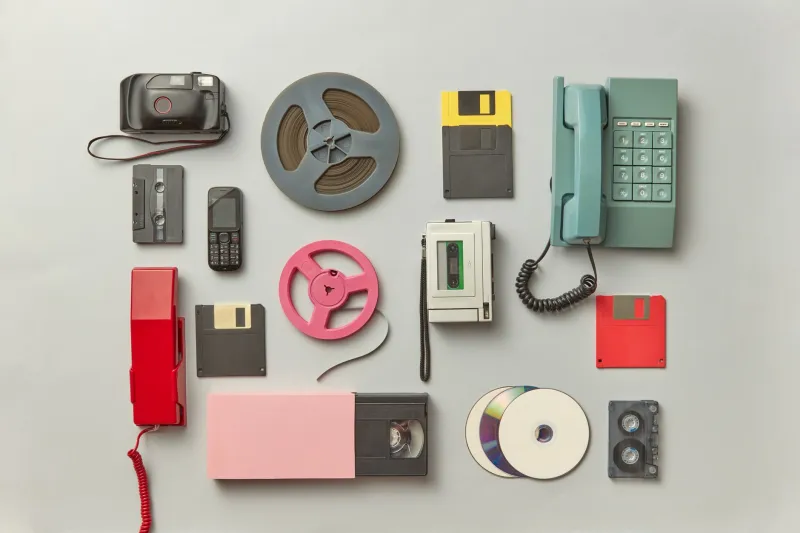
The shoebox was labeled "MISC — MOM" in my mother's handwriting, which is the family equivalent of a black hole. Inside: birthday cards, a dried-out highlighter, two keys to doors I no longer own, and a small cassette tape in a cracked case. The label read, in ballpoint pen: Machine tape — do not tape over!!
Mom, if you're reading this: I taped over part of it. Sorry. But not the good part.
The Machine That Answered for All of Us
For those too young to remember: before voicemail lived in your pocket, it lived in a plastic box the size of a hardcover book, and it recorded onto an actual cassette tape. Ours sat on the kitchen counter in Ohio, blinking a red number at the room like it was keeping score.
Here's the thing I'd forgotten — the tape was shared. Every outgoing message we recorded erased the last one. Every incoming message erased the one before that. It wasn't an archive. It was a rolling window, maybe twenty messages deep, into whoever had called us most recently.
Which means the tape I found wasn't a curated memory. It was an accident. And that's exactly why it wrecked me.
What's On the Tape
I bought a $14 cassette player from a pharmacy, because apparently 1997 follows you around until you make peace with it. Then I pressed play in my car, alone, in a parking lot — the natural habitat of all emotional breakdowns.
The first voice was my grandmother, who died in 2011. She was calling to remind my mom about a church potluck and then, mid-sentence, got distracted by something on her stove. You can hear her walk away. The machine just kept recording her empty kitchen for another eight seconds.
Then my Uncle Ray, calling from his truck, something about deer season, the receiver of a payphone clanking in the background. Then a friend of my sister's whispering "is Danny there" in the tone of a girl who absolutely did not want Danny's mother to know she was calling. Then, in a stunning tonal whiplash, an automated message from the cable company informing us our payment was — and I quote the tape — "seriously, seriously overdue."
My mother had apparently yelled at a representative the week before. There's a follow-up call from the cable company that I can only describe as a hostage negotiation. Mom won, by the way. She always won.
We Used to Rehearse Ourselves
The outgoing greeting was the strange, beautiful part. My family re-recorded that message constantly. For a while it was all four of us kids shouting "WE'RE NOT HOMEEEEE" in unison. Then, one Christmas, my dad did a solemn, news-anchor version that lasted exactly thirty seconds and fooled at least two people into hanging up without leaving a message.
We were composing ourselves. Thirty seconds at a time, we decided what version of our household the world would hear when we weren't there. It was amateur theater with an audience of everyone who cared enough to call twice.
Nobody does that now. Your voicemail greeting, if you have one, is probably the factory default, or a bored "Hey, it's me." And honestly, fair. But something got lost: the small, deliberate act of performing your own life for the people trying to reach you.
What the Always-On Present Took
Here's my actual opinion, the thing this whole shoebox archaeology project was building toward: we've traded accidental memory for total documentation, and we got the worse end of the deal.
Your phone records everything and preserves nothing meaningfully. Twenty thousand photos in the cloud, most never looked at twice. Every call transcribed, every voice memo filed. But when was the last time you stumbled across a recording of someone you loved and heard them laugh — really heard it — with no warning?
The answering machine tape worked because it was finite. Twenty messages. That's the budget. When it filled up, you had to decide what was worth keeping, and my mother, God bless her, decided a stranger from the cable company and eight seconds of my grandmother's empty kitchen were worth saving.
She was right. The kitchen recording is the best thing I own.
The Part Where I Tell You to Do Something
I'm not going to tell you to buy a cassette recorder. I'm not nostalgic for the technology — the tape hiss, the rewinding, the fact that you had to physically hold a button down while it rewound, which built character.
But here's the assignment, and I'm giving it to myself too: record something on purpose, and then lose track of it. A voice memo of your kid telling a story badly. Your dad explaining how to fix the garbage disposal for the fourth time. Don't organize it. Don't back it up to three clouds. Just let it exist somewhere you'll forget about, so that in twenty years, future-you gets ambushed by it in a parking lot like I did.
The machines answered for us once. Turns out they were also listening — and occasionally, if you're lucky, they kept the good parts.