Thirty Evenings in a Rocking Chair: What My Front Porch Taught Me About the People I Never Knew I Needed
There's a photograph in my grandmother's album — slightly curled, sun-faded at the edges — of about ten people crammed onto a porch I grew up thinking was impossibly small. Neighbors, not relatives. Someone's holding a glass of iced tea. Someone else is mid-laugh, caught off guard. The house belonged to a woman named Mrs. Delaney, who, according to family lore, knew everything worth knowing on the block simply by sitting outside after supper.
For most of American history, that was how you kept up. The porch wasn't an architectural flourish. It was infrastructure — social infrastructure, the kind no city planner ever had to budget for.
The Porch Had a Job, and It Did It Well
Think about what a front porch actually accomplished. It put you in plain sight of the sidewalk. It made you available — not obligated, just available — to whoever wandered past. Conversations started with a nod and ended forty minutes later with a borrowed ladder or a casserole promise.
Sociologists have a term for the light-touch interactions porches produced: weak ties. The casual acquaintances who aren't close enough to lean on in a crisis but who make a neighborhood feel like a neighborhood. Research going back decades suggests these ties do quiet, heavy lifting — the neighbor who notices your car hasn't moved, the guy two doors down who mentions a job opening in passing.
The porch was a weak-tie machine. And then we unplugged it.
Nobody Sabotaged the Porch. We Just Stopped Needing It.
The usual suspect is air conditioning, and honestly, the accusation holds up. Once the indoors became comfortable in July, the appeal of sweating through a screened conversation dropped considerably. Add in the postwar shift toward the backyard — patios, decks, privacy fences — and the porch went from social hub to decorative afterthought. Plenty of new houses stopped including one at all.
There were other forces, too. Television gave us a reason to stay in that didn't involve anyone else. Cars turned the street from a place people lingered into a corridor people passed through. And somewhere along the way, sitting out front started to feel vaguely exposed — like you were announcing your availability and nobody had asked for it.
I felt that awkwardness myself, which is why I decided to test it. For thirty consecutive evenings, I sat on my front porch from roughly six to seven-thirty. No phone scrolling past the occasional photo. No headphones. Just a chair, a drink, and whatever the street offered up.
Week One Was Genuinely Awful
I want to be honest about this: the first several nights were uncomfortable in a way I didn't expect. I felt watched. A few people glanced at me like I was selling something. One kid asked if I was waiting for someone. I nearly quit on day four.
But here's what happened by the end of the second week: people started waving first. Then stopping. The retired teacher across the street — three years of living near her, and I'd never once spoken to her — told me about the flood that gutted her basement in 2019. A dad walking his dog asked if I knew anyone who babysits, because apparently I now looked like someone who might. By week three, a couple of neighbors had started dragging their own chairs out around the same time, and we fell into something that wasn't quite a gathering and was more than coincidence.
It took roughly three weeks to build what my grandmother's generation got for free.
The Porch Is Making a Quiet Comeback
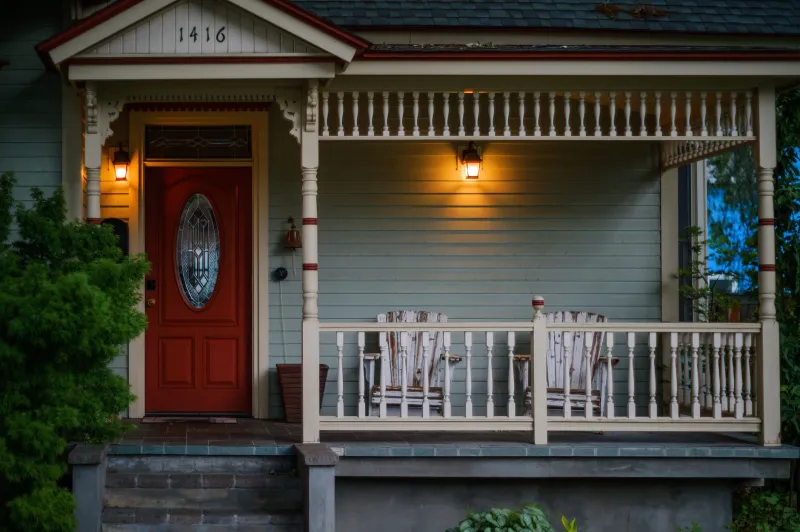
Here's the hopeful part: the porch never fully left, and some developers have noticed. New Urbanist communities — places like Celebration in Florida or the newer traditional-neighborhood developments scattered through the Carolinas and Georgia — deliberately design wide front porches into their houses, betting that proximity plus visibility equals community. Real estate listings have started treating "deep front porch" as a selling point again, right up there with quartz countertops.
The logic is sound. You can't wave at people you can't see. And a growing number of Americans, lonely in ways they struggle to name, are realizing that a bigger backyard deck with a fence around it didn't actually solve anything.
You Don't Need a Porch. You Need Ten Feet of Front-of-House.
My experiment ended, but the habit didn't. I'm out there most evenings now, not as a stunt but because it's simply where I'd rather be. Some nights nobody stops. Some nights it's the best forty minutes of my day.
If you've got steps, a stoop, a folding chair and a sliver of concrete — you've got a porch. The whole thing requires no renovation, no budget, no app. Just the willingness to be visible and a little bored in public, which turns out to be the price of admission to knowing the people who live around you.
Mrs. Delaney, I've come to believe, wasn't nosy. She was just doing the job the rest of us outsourced to our phones and then wondered why we felt so alone.