The Cold Case: What a Refrigerated Shelf of Casseroles Knows About Your Whole Town
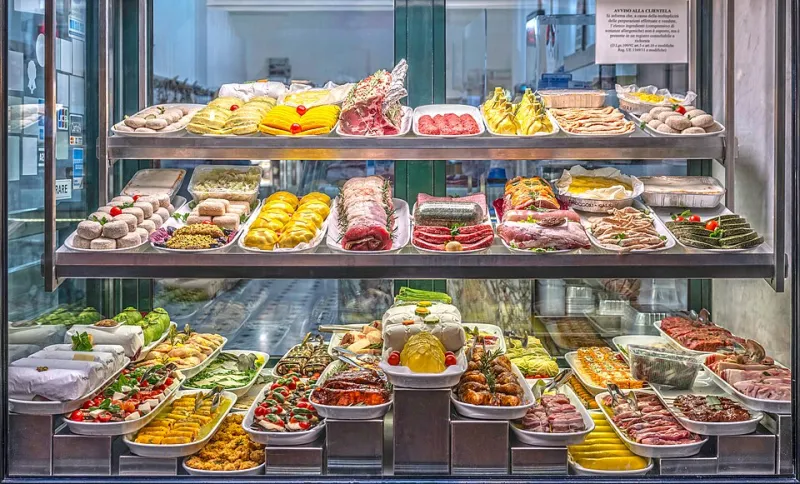
Photo: Wilfredor, CC0, via Wikimedia Commons
The case hums. That's the first thing you notice if you ever stop long enough to really look at it — the low mechanical drone of the refrigerated shelf at the back of a midwestern grocery store, the one stacked with foil pans of pot pie, tubs of mac and cheese with the lid slightly ajar, and something the label optimistically calls 'Chicken & Noodles — Family Size.'
Most of us blow past it on the way to the milk. I didn't. I spent three weeks loitering by that case at a Kroger-affiliated store in a town of about 9,000 people, and I'm here to tell you: it's the most honest real estate in the building.
Nobody Lies Next to the Pot Pies
The produce section is where people perform. We select the avocados we intend to eat and pose with the kale we won't. The snack aisle is aspiration. But the casserole case? Nobody comes down here to be seen. They come because it's Tuesday, they're tired, and a foil pan of something beige is the correct answer to the question the day asked.
I watched a man in a Carhartt jacket pick up two pans of scalloped potatoes, hesitate, then put one back. 'Her folks are in town,' he said to nobody in particular, explaining himself to an empty aisle. 'One's enough for that crowd.'
That's the thing about this shelf. It doesn't just feed people. It narrates them.
The Deli Manager Who's Seen Everything
Darlene has run the deli and prepared-foods counter for twenty-nine years. She has a standing desk situation behind the counter, a pair of reading glasses on a chain, and the calm authority of someone who has portioned potato salad through four presidencies.
'People think I sell food,' she told me, sliding a tray of baked ziti into the case. 'I sell time. That's the product. You can't make a lasagna after work and also go to your kid's game. So you buy mine, and you put it in your own dish, and everybody wins.'
She keeps a mental ledger of the town's rhythms. Casserole sales spike after funerals — always within about ten days, always in multiples, always ordered by someone who says 'just put it on my account' in a voice that's holding together. Sales dip the week after a high school graduation, when everyone's too busy to eat anything sitting down. And in October, when the football schedule comes out, she preps double batches of mac and cheese for home games.
'New baby in the family, I can usually tell,' she says. 'Somebody comes in, buys three different things, no pattern, whatever's easy to reheat. That's a casserole train. Those pans are going to a young mother who hasn't slept.'
Convenience Is a Love Language
We spend a lot of cultural energy sneering at convenience food. The think pieces about ultra-processed everything. The shame spiral at the checkout. And sure, there's a real conversation to have about what's in that foil pan.
But here's what the think pieces miss: the pan itself is a message. When you show up at a widow's door with a store-bought chicken and rice bake, you are not saying 'behold my culinary skill.' You are saying 'I thought about what your evening looks like, and I decided you shouldn't have to figure out dinner.' That's care. The packaging is irrelevant. The showing up is everything.
A woman named Ruth, maybe seventy, told me she's been buying the same tub of mac and cheese every Sunday for six years — 'since Walt passed. Used to be he'd want fried chicken. Now it's just me, and this is close enough to what I'd make if I felt like making it.' She smiled. 'I don't feel like making it.'
That's not laziness. That's a person renegotiating her life one Sunday at a time, and the casserole case holding a small piece of the load.
The Aisle as a Town Record
If you wanted to write the history of this town, you could do worse than Darlene's sales logs. The year the plant closed, she says, family-size pans outsold singles for the first time — adult kids moving back home, whole households eating together again out of necessity. During the pandemic, everything went to the curbside bins, but the orders didn't stop. 'People still needed to feed their people. They just couldn't come say hi.'
And the funeral casserole, she notes, has quietly evolved. 'Used to be it was all hotdishes. Now I get asked for the gluten-free one, or the vegetarian. Grief changes but it still wants to be fed.'
What I Brought Home
I'll admit it: by week two, I was buying from the case myself. A pot pie here, a container of cheesy potatoes there. And I stopped feeling weird about it somewhere around the third pan.
Because here's my conclusion, after all that loitering: the casserole shelf isn't a monument to our failure to cook. It's a monument to our refusal to let each other go hungry just because life got complicated. It's the friend who shows up, the neighbor who doesn't ask too many questions, the deli lady who remembers your order and your reason for ordering it.
The pan is disposable. The gesture isn't.
Buy the ziti. Put it in your own dish if it makes you feel better. Feed somebody.