Everything Must Go: A Summer of Saturdays in My Neighbors' Driveways
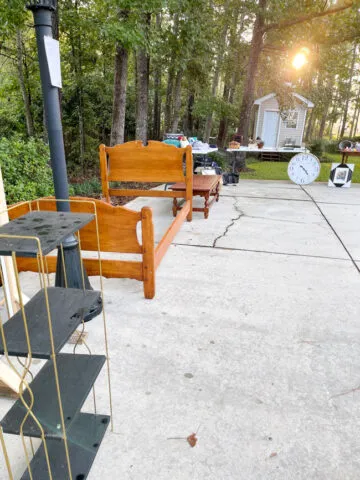
Photo: suburban garage sale driveway folding tables morning, via lifeonsummerhill.com
The Rules I Set for Myself
Sometime in early June, on a whim I can't fully explain, I decided I would attend every garage sale on my street — and the two streets that branch off it — for the entire summer. No online marketplace pickups, no antique mall detours. Just hand-painted signs, folding tables, and whatever my neighbors decided the world needed less of that week.
I gave myself three rules. Spend no more than ten dollars per sale. Talk to whoever was behind the table. And never leave without buying something, even if it was a quarter box of screws I'd never use.
By August, I owned a bread machine, a set of encyclopedias from 1988, a fishing rod, a wedding cake topper, and roughly forty pounds of other people's decisions. But the stuff was never the point. What I came home with every Saturday was something closer to an anthropology degree in the life stages of suburban America.
Nobody Sells Their Best Years at a Table
Here's what I figured out by mid-July: garage sales are not retail. They are grief management with a cash box.
The couple on the corner — the ones with the polite sign in the yard about their changed living situation — were selling an entire shared household in one weekend. Two of everything, priced to move, and a tension in the air you could've hung a coat on. She was friendly. He was not. The exercise bike went for twenty dollars and neither of them made eye contact when it did.
Down the block, a woman was selling the contents of her mother's apartment. Everything was labeled in her mother's handwriting: "Christmas stuff," "good towels," "DAD'S TOOLS — DON'T GET RID OF." She'd gotten rid of it anyway, and now she was watching strangers haggle over a $3 socket set that the label explicitly said not to get rid of. I bought the socket set. It felt like the least I could do.
And then there were the baby sales — the most joyful and most brutal category. Racks of onesies, a crib, a stroller with the ghost of a crushed goldfish cracker still in the cup holder. The parents were always a little dazed, always a little proud. "We're done," one dad told me, and he said it the way you say a final score.
The Prices Are a Fiction and Everyone Knows It
Garage sale pricing is a folk economy with no relation to actual value. A leather jacket is $2. A plastic pumpkin is $5, because "it was a decoration." A box of VHS tapes is free if you take the box. A ceramic frog is $40 and non-negotiable, because a grandmother loved it once.
Nobody expects to make money. I watched one man net $31.50 over six hours and call it "a pretty good weekend." What he actually made was three conversations with retired neighbors, a referral for a roofing guy, and one hour of feeling useful to strangers. Try getting that return at a big-box store.
This is the part we underrate: the garage sale is the last truly local social network. No algorithm decides who shows up. No feed curates the inventory. The recommendation engine is a woman named Diane who tells you the bread machine "works great, my husband just won't use it." The comment section is a guy holding up a lamp and saying "my wife had one just like this," and meaning his whole childhood in five words.
What America Is Secretly Selling
If you tally it up, here's the inventory of one suburban summer, street-level view:
- Retirements. Toolboxes sold by men who suddenly had nowhere to be at 7 a.m.
- Divorces. Sold gently, or not gently at all, usually on the same weekend.
- Empty nests. Sold in the form of bunk beds and prom dresses and a viola nobody played after sophomore year.
- Deaths, delayed. Sold by adult children a year or five later, once it became bearable.
- Ambitions, quietly shelved. The guitar with new strings and no wear on the frets. The bread machine, still in its box.
Every sale is a person telling you, in the universal language of sticker prices, this chapter is over. And every buyer is a person saying I'll take it from here.
The Last Saturday
On the final weekend of my experiment, a family a few doors down held a sale before a military move. Everything had to go — furniture, bikes, the good grill. By noon the driveway was down to odds and ends, and the mom just started giving things away. "Take the cooler," she said. "We can't ship a cooler."
I gave her five dollars anyway and took the cooler, and we stood there for a minute while her kids ran around the driveway one last time. She said the thing I heard all summer, the thesis statement of the entire American garage sale:
"It's just stuff. But it's weird, right?"
It is weird. It's weird and it's tender and it happens every Saturday morning from April to October on thousands of streets exactly like mine. No app will ever replicate it. You have to show up, hold the cash, and take the cooler.
The bread machine, by the way, works great. I've used it twice.